Bagster vs. Dumpster Rental in Austin: Which Makes More Sense for a Small Cleanup?
If you need to rent a dumpster in Austin for a garage cleanout, yard project, or small remodel, you may be comparing a Bagster-style debris bag with a residential roll-off dumpster. Both can work for the right job. The better choice depends on what you are throwing away, how much material you really have, how quickly you need pickup, and whether your cleanup is likely to grow once work starts.
For many Austin-area homeowners and project managers, the decision comes down to one practical question: is this truly a small, light cleanup, or is it the kind of project that starts small and turns into a bigger pile of debris than expected? That is where a side-by-side comparison helps.
This guide breaks down the real differences in plain language so you can choose the simpler option for your situation. If you already know you want a roll-off, you can review roll off dumpster rental Austin options or explore Austin dumpster service for residential projects as you compare.
Bagster vs dumpster rental: the quick difference
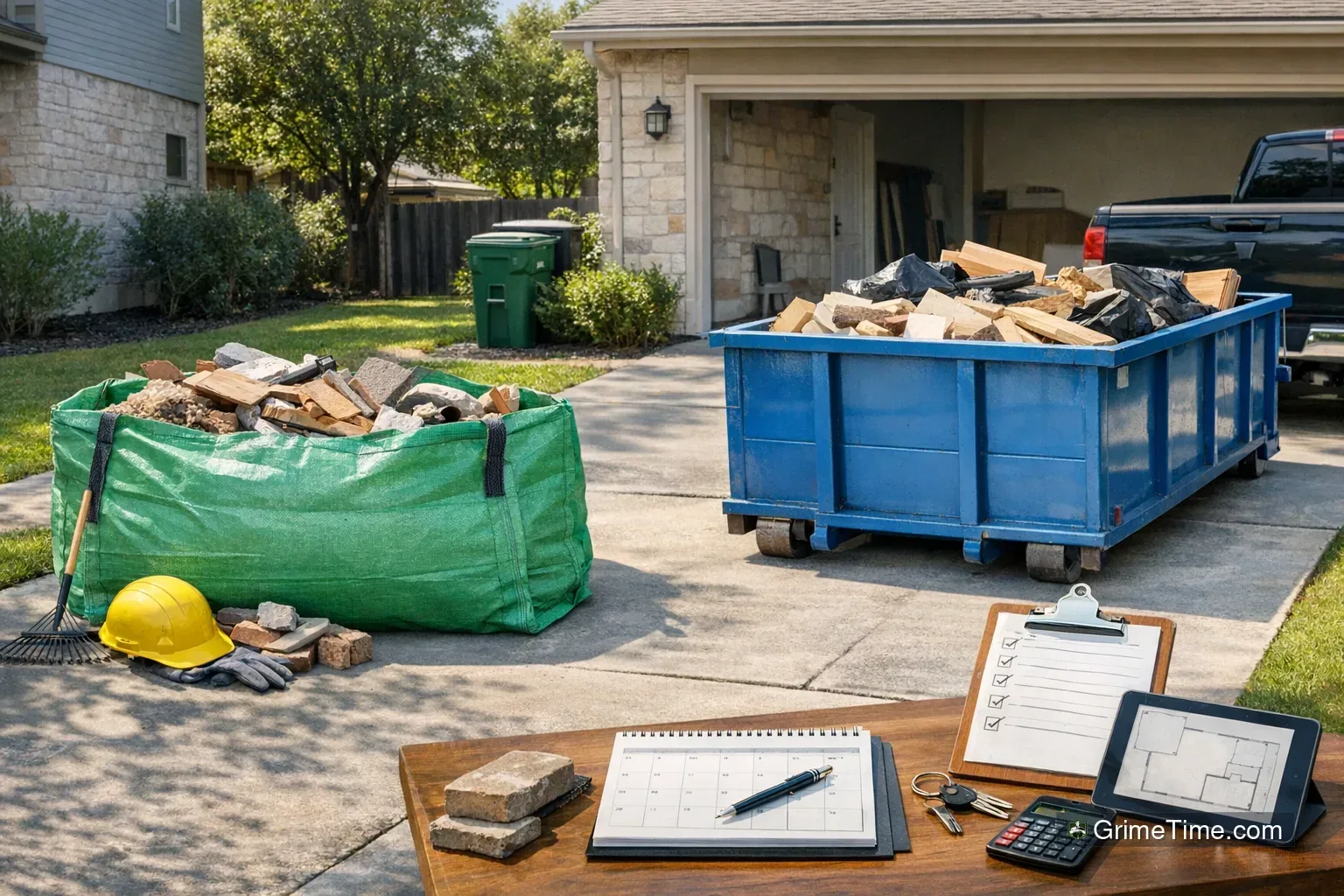
A Bagster-style option is a heavy-duty disposable debris bag that you buy, unfold, fill yourself, and then arrange to have picked up if the material and placement meet that provider’s rules. A roll-off dumpster rental is a metal container delivered to your property for a set rental period, then hauled away by the dumpster company when you are done.
That sounds simple, but the day-to-day experience is different.
How a Bagster-style debris bag works
- You buy the bag separately.
- You place it where pickup access will work.
- You load it yourself and stay within the bag’s fill line and weight limits.
- You schedule pickup based on that provider’s service availability and rules.
Bagster-style bags are often considered for very light cleanups because they take up less space before they are filled. They can be a fit when the debris is limited, not too heavy, and easy to stage in a pickup-friendly spot.
How a residential roll-off dumpster works
- The dumpster company delivers the container to your driveway or approved placement area.
- You load debris over the rental period.
- The hauler returns and removes the container.
- The rental is built around project debris, not just one bag of material.
For Austin homeowners, contractors, and remodel customers, a dumpster is usually the more practical choice once the debris includes bulky items, remodel waste, heavier materials, or a cleanup that may last more than a day or two.
The simplest way to think about it
A Bagster is generally best for a very limited amount of light debris and a pickup setup that meets strict access rules. A roll-off dumpster is usually better when you need easier loading, more room, more flexibility on timing, and fewer surprises once the project is underway.
That is why people searching for a small cleanup dumpster Austin option often end up choosing a roll-off even when the project looked small at first.
When a Bagster makes sense for a small cleanup
It is fair to say that a Bagster-style option can make sense in some cases. Not every project needs a roll-off. If the debris is truly limited and light, the simpler bag format may be enough.
Good fit situations for a Bagster-style option
- A very small garage cleanout with mostly light, non-bulky junk
- A minor yard cleanup with baggable clippings or small, light debris
- A cleanup where you do not need much loading room
- A project with enough time to work around pickup scheduling rules
- A property where a small footprint matters more than loading convenience
For example, if you are clearing a corner of the garage and getting rid of broken storage bins, cardboard, old toys, and a small amount of general clutter, a debris bag may be enough. If your yard cleanup involves only lightweight trimmings and not dense soil, masonry, or large brush piles, it may also be workable.
Projects that stay small from start to finish
The key phrase is stay small. Many cleanups do not. Homeowners often start with “just cleaning out the garage” and then pull in an old shelving unit, a damaged workbench, scrap wood, carpet remnants, old fencing, or leftover remodel debris. Once that happens, the convenience gap between a bag and a dumpster becomes much more obvious.
When the debris is light rather than dense
Bag-style containers are more likely to work when the waste is low-density. Think light household clutter, small pieces of packaging, or limited yard debris. The more your material shifts toward shingles, tile, plaster, drywall, wood, fencing, dirt, or broken concrete, the more likely weight and loading practicality will become an issue.
When placement and pickup conditions are favorable
Pickup logistics matter. A bag is not just “set it anywhere and forget it.” It needs placement that works for the pickup equipment and service model. If your property has overhead tree cover, parked cars, narrow access, sloped terrain, or awkward placement zones, that can complicate things.
In denser Austin neighborhoods, especially where curb space is limited or alley access is tight, it is worth thinking through access before choosing a bag over a dumpster.
When renting a dumpster in Austin is the better choice
In many real-world cleanup situations, renting a dumpster in Austin is the better choice because it gives you more working room, more flexibility, and a container built for project debris rather than a highly limited pile.
A dumpster usually wins when debris volume is uncertain
If you are not completely sure how much junk, construction debris, or cleanup waste you will generate, a roll-off is often the safer choice. This is especially true for:
- Garage cleanouts that have built up over several years
- Pre-move or estate cleanouts
- Bathroom or kitchen tear-outs
- Flooring removal
- Fence replacement
- Deck repair
- Roofing or siding touch-up projects
These jobs regularly produce more debris than expected. A bag can look economical at the start, but if you outgrow it quickly, you lose time and end up dealing with a second disposal plan.
Heavier debris changes the decision fast
One of the biggest decision points is weight. A cleanup can appear small by volume while still being heavy by disposal standards. A pile of tile, dense lumber, old countertops, broken brick, or wet yard debris adds up quickly. That is where a residential dumpster rental Austin option often makes more sense than a disposable bag.
If your project includes any of the following, lean toward a dumpster and confirm the material with the rental company:

- Drywall
- Wood framing
- Cabinets
- Flooring
- Shingles
- Fence panels
- Deck boards
- Dirt or sod
- Brick, block, or concrete
Loading convenience matters more than people expect
A roll-off dumpster is simply easier to load for most projects. You get a larger container opening and a sturdier setup designed for repeated loading during active work. That matters when you are carrying awkward material like drywall sheets, long trim pieces, bulky furniture, or demolition debris.
It also matters when multiple people are working at once. Contractors, remodel crews, and busy homeowners usually want debris to go directly into the container instead of staging piles, cutting pieces down further, or trying to keep every item within a smaller bag format.
Project timing is often easier with a dumpster
Cleanup jobs in Austin rarely happen in a perfectly controlled timeline. Weather shifts. Contractors run behind. Homeowners find extra debris. HOA rules or access issues change the work plan. A roll-off dumpster rental is often easier to coordinate around a real project schedule.
If you are planning around a remodel, move-out date, rental property turnover, or a weekend cleanout, it helps to have a container on-site that is ready to use throughout the project instead of depending on whether a pickup can happen right when you want it.
A dumpster is often the better Bagster pickup alternative in Austin
Many people searching for a Bagster pickup alternative Austin option are not necessarily looking for something bigger for the sake of it. They want fewer restrictions and less guesswork. A roll-off often solves the practical issues that come up with debris bags:
- More room for bulky materials
- Better fit for remodel debris
- Less concern about outgrowing the container immediately
- A simpler setup for driveway loading
- Better alignment with multi-day cleanup work
If that sounds closer to your project, review affordable dumpster rental in Austin options with the understanding that the best value is not just about the starting cost. It is about getting the right container the first time.
Cost, capacity, and pickup timing compared
This is usually the section people care about most, and it deserves a practical answer rather than vague sales language.
Is a Bagster cheaper than renting a dumpster in Austin for a small cleanup?
Sometimes, for a truly small and light cleanup, a bag-style option can cost less overall. But that is not always the case once you factor in the full job instead of just the container format. Total value depends on:
- How much debris you actually have
- Whether the material is accepted
- Whether the debris stays within weight rules
- Whether pickup access is straightforward
- Whether you end up needing more than one disposal method
The reason this comparison can be misleading is that many small cleanups are only “small” before work begins. Once demolition starts or clutter gets pulled out into the open, the volume grows. At that point, the cheaper-looking option may no longer be the easier or more economical one.
That is why dumpster rental cost Austin questions should be tied to project type, debris type, and expected volume rather than a broad citywide price assumption.
Capacity: what fits in a bag versus a small roll-off?
The official Bagster product documentation is the right place to verify its exact capacity, dimensions, and weight limit because those details need to stay accurate to the manufacturer. In practical terms, though, a small roll-off dumpster offers substantially more usable room and easier loading for awkward debris.
The biggest difference is not just raw capacity. It is usable capacity.
Usable capacity matters more than stated capacity
With a debris bag, you need to think about:
- How high you can fill it
- How evenly weight is distributed
- Whether items need to be broken down smaller
- Whether bulky items fit the opening and shape
With a roll-off dumpster, the container is designed for active loading during a project. That means you can usually work faster, keep the site cleaner, and avoid wasting time trying to cut, stack, or compact material just to make it fit.
Pickup timing: flexibility versus fixed service conditions
Pickup timing is another major separator in the bagster vs dumpster rental decision.
A Bagster-style service depends on that provider’s pickup process, coverage area, and access requirements. A dumpster rental is tied to a scheduled delivery and removal window coordinated with the rental company. For homeowners and contractors who need to line up cleanup with labor, inspections, remodel phases, or move-out schedules, that coordination often matters more than they expect.
What if I need the container picked up quickly in Austin?
If you need quick turnaround, a roll-off dumpster rental is often easier to plan around because your project starts with a known delivery and service arrangement. That does not mean every job gets same-day or immediate service, and it would be wrong to promise that without checking availability. It does mean that timing is a core part of the rental conversation.
If your cleanup is in Austin, South Austin, Buda, Georgetown, Hutto, Dripping Springs, Kyle, Elgin, Pflugerville, San Marcos, or Round Rock, it helps to discuss the project schedule before you choose the container format. Local route planning, neighborhood access, and debris type all affect what timing will make the most sense.
Value is not just about the first number you see
For a small project, real value comes from asking:
- Will I need more space than I think?
- Is my debris likely to be heavy?
- Do I need simple loading for bulky items?
- Do I need the container on-site for several days?
- Will pickup logistics be easy at my property?
If the answer to several of those is yes, a roll-off often delivers better overall value than a bag that only works if everything goes exactly to plan.

What you can and cannot throw away
Whether you choose a debris bag or a roll-off dumpster, disposal rules matter. Material restrictions are one of the fastest ways a small cleanup gets more complicated than expected.
Common materials that are often acceptable in residential cleanup containers
Depending on the container type and local disposal rules, common accepted materials may include:
- General household junk
- Furniture
- Cardboard and packaging
- Wood debris
- Drywall
- Yard debris
- Minor remodeling waste
Acceptance is never universal across every provider or every disposal site, so it is always best to verify the exact material list before loading.
Common restricted or special-handling materials
Some materials are often restricted, prohibited, or require special handling. Examples can include:
- Paints, solvents, and chemicals
- Batteries
- Tires
- Propane tanks
- Asbestos-containing material
- Certain appliances
- Freon-containing equipment
- Medical waste
- Hazardous waste
For Austin-specific disposal rules, Austin Resource Recovery is a useful source for bulk item guidance and local waste handling expectations. For state-level rules on prohibited materials and waste handling, the Texas Commission on Environmental Quality is also a relevant reference point.
What kinds of materials are harder to dispose of with a Bagster or a dumpster?
The hardest materials are usually the ones that are:
- Hazardous
- Very dense or unusually heavy
- Regulated
- Difficult to load safely
- Subject to landfill restrictions
For example, bagging up light garage clutter is one thing. Loading old tile, chunks of masonry, or questionable chemicals from a shed is another. Even when a material seems common, the disposal method may change based on weight, handling risk, or local site rules.
Remodel debris needs more caution than basic junk
Homeowners doing light renovation work often assume demolition debris is all the same. It is not. Cabinets, drywall, trim, flooring, and countertops are common project wastes, but they differ in weight, breakage, dust, and loading difficulty. The more your cleanup leans toward construction debris rather than household clutter, the more likely a roll-off is the safer and more practical choice.
Yard debris can be deceptively heavy
A few branches do not weigh much. Wet brush, bundled limbs, dirt, sod, stumps, or mixed yard waste can be another story. If your yard cleanup involves anything beyond very light trimmings, ask about material rules first. Heavy natural debris is one of the most common reasons a “small” cleanup stops behaving like a small cleanup.
Austin-specific factors: space, access, and neighborhood logistics
The Austin area adds some local considerations that can affect whether a bag or a dumpster is the simpler option.
Driveway space and placement matter
Not every property has the same layout. Central Austin lots, South Austin homes with tighter driveway arrangements, and suburban properties in places like Round Rock, Pflugerville, or Georgetown can all have very different loading conditions.
Think about:
- How much flat surface you have
- Whether vehicles need to stay parked on-site
- Whether garage access needs to remain open
- Whether tree branches or utility lines affect placement
- Whether the street layout makes delivery or pickup harder
A bag may seem smaller and easier, but it still needs pickup access that actually works. A dumpster takes more space, but the setup is straightforward when the delivery area is planned correctly.
Older neighborhoods and tighter streets
In some Austin neighborhoods, access is the deciding factor. Narrow streets, alley service patterns, parked cars, HOA restrictions, and tree canopy can all influence which option is more practical. This is especially worth discussing in areas with less forgiving curb access or shared parking.
If your project is in the southern part of the city, you can also review South Austin dumpster rental availability for a more location-specific starting point.
Heat, weather, and project duration
Central Texas weather can stretch or compress a cleanup schedule. A one-day plan can turn into several days if rain delays outdoor work or summer heat slows labor. That makes timeline flexibility more important than many homeowners expect.
If you want to work steadily over a weekend, clear out a house room by room, or load debris as contractors move through different phases, a dumpster usually fits the rhythm of the work better than a bag that you are hoping to fill all at once.
Bulk item and special waste rules in Austin
Austin has its own local expectations around what belongs in routine trash service, what may count as bulk disposal, and what requires different handling. That matters when you are deciding whether a bag or dumpster is the right landfill-alternative planning tool for your cleanup. Checking Austin Resource Recovery guidance before the job can help avoid surprises, especially with bulky furniture, remodeling waste, appliances, or problem materials.
Contractors and project managers need staging efficiency
For contractors and commercial or residential project managers, the comparison is usually less about the smallest possible container and more about keeping the site moving. If crews are doing flooring removal, punch-list work, tenant turnover, or repair work across multiple days, staging debris into a roll-off keeps the site cleaner and reduces handling.

That is often the more efficient answer than trying to make a disposable bag work on an active jobsite.
How to choose the right option for your project
If you are still weighing a bagster vs dumpster rental decision, the easiest way to choose is to answer a few practical questions honestly.
1. What kind of debris do you have?
If it is mostly light household junk, a small amount of packaging, or limited clutter, a bag may be enough. If it includes remodel debris, bulky furniture, fencing, wood, drywall, flooring, or dense yard waste, a dumpster is usually the better fit.
2. Is the project really small, or just starting small?
This is the most important question. Many projects outgrow the original estimate. Signs your cleanup may outgrow a bag include:
- You are clearing multiple rooms, not one corner
- You expect to remove bulky items
- You are tearing out any building material
- You already have a growing staging pile
- You are saying “we might also get rid of…” more than once
3. Will the debris be heavy?
Heavy debris changes the decision quickly. Tile, shingles, wood, dirt, and demolition material can turn a small-volume cleanup into a weight problem. If you are unsure, ask before choosing.
4. How long will the cleanup take?
If you want to load gradually over several days, a dumpster is often the better fit. If you truly have one contained pile of light material ready to go and pickup conditions are easy, a bag may work.
5. How easy is access at your property?
Look at overhead clearance, parked cars, driveway slope, tree limbs, and neighborhood traffic. If access is tricky, talk through the site layout before deciding.
6. Do you need loading convenience?
If you are carrying awkward or bulky material, a roll-off’s ease of loading matters. It can save labor, reduce mess, and keep the cleanup moving.
Simple examples by project type
Garage cleanup example
If you are removing a few light boxes, broken household items, and small clutter, a bag may be enough. If the garage also contains old shelving, lumber scraps, a workbench, damaged furniture, and years of overflow storage, a dumpster is likely the more practical option.
Yard cleanup example
If it is mostly light brush and a few bags of trimmings, a bag might work. If the cleanup includes limbs, fencing, soil, sod, or storm debris, a roll-off is often the better choice.
Light renovation example
If you are doing even a modest bathroom, kitchen, flooring, or closet remodel, debris usually gets bulky and heavy fast. That is where a roll off dumpster rental Austin option usually makes more sense than trying to contain everything in a disposable bag.
FAQ: common Austin questions about small cleanup disposal
How much junk fits in a Bagster compared with a small roll-off dumpster?
A small roll-off generally gives you more usable space and easier loading for bulky items. For the exact Bagster dimensions and weight limit, check the official WM Bagster documentation. For real cleanup planning, remember that shape, weight, and loading convenience matter as much as stated capacity.
How do I know when a small cleanup has outgrown a Bagster?
If your debris includes bulky items, remodel materials, dense waste, or more than one small pile, it may already be beyond the point where a bag is the easiest solution. Another warning sign is when you start planning a second disposal trip before the first container is even filled.
What if I only have a driveway and limited space?
Limited space does not automatically rule out a dumpster or make a bag the best choice. The right answer depends on driveway dimensions, overhead clearance, parking needs, and pickup access. In some cases, a planned dumpster placement is actually simpler than trying to create the exact pickup conditions a bag requires.
Are there materials I should ask about before ordering either option?
Yes. Always ask about paint, chemicals, batteries, tires, appliances, mattresses, concrete, dirt, roofing material, and any demolition waste that may be unusually heavy or restricted.
Is a dumpster only for large construction jobs?
No. That is a common misconception. Residential dumpster rentals are often used for garage cleanouts, downsizing, estate cleanouts, moving prep, yard projects, and small-to-mid-size remodeling work. A dumpster is not just for major commercial construction.
Choosing the simpler option for your Austin cleanup
If your project is truly light, limited, and easy to stage for pickup, a Bagster-style option may do the job. But if your cleanup includes bulky debris, uncertain volume, heavier materials, or a timeline that needs flexibility, renting a dumpster in Austin is often the more practical path.
The main goal is not choosing the smallest-looking option. It is choosing the option that fits the real amount of debris, the actual layout of your property, and the way your cleanup will unfold once work begins.
Grime Time Dumpster Rentals helps Austin-area homeowners, contractors, and property managers think through that decision in a straightforward way. If you want help comparing your debris type, expected volume, driveway space, and schedule, call 512-387-5802. You can talk through whether a bag-style approach or a residential roll-off makes more sense for your job, choose the right container size, and get pricing for an Austin dumpster rental without overbooking.